OSI and TCP/IP Networking Models
Author(s): a_person
Last Updated: 11/27/2025
Recommended Prerequisites (click to expand)
None
Networking models categorize and provide a structure for networking protocols and standards. There are 2 main networking models for network communication: the OSI model and TCP/IP model.
The OSI Model
The Open Systems Interconnection (OSI) model, developed by the ISO, categorizes network functions into seven layers.
- Physical - This layer describes the mechanical, electrical, and functional methods to start and maintain physical connections for bit transmission.
- Data Link - This layer defines how data is formatted and exchanged for transmission over physical medium. It may also detects errors and manages node-to-node delivery.
- Network - This layer provides connectivity between end hosts on different networks. It uses logical addressing (IP Addressing), and provides path selection. Routers operate on this layer.
- Transport - This layer segments(takes large data and makes it smaller) and reassembles data as well as defines how data should be transfered for individual communication between end devices. This causes there to likely be less problems.
- Session - This layer establishes, manages, and terminates connections between local application and the remote application.
- Presentation - This layer formats the data to the appropriate format to be sent over the network.
- Application - This layer is used in software and identifies communication partners and synchronizes communication.
The TCP/IP Model
The TCP/IP model was created by the US Department of Defense and maintained by the IETF. Unlike the OSI model, the TCP/IP model is divided into 4 layers, and matches closely how modern networks actually work.
The 4 Layers of TCP/IP
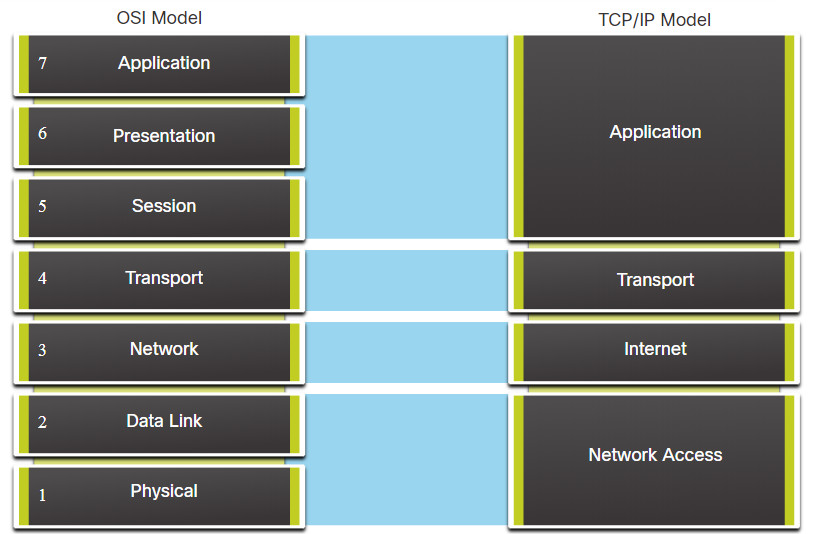
- Network Access - Maps to physical and data link layers of the OSI model.
- Internet - Directly maps to network layer of the OSI model.
- Transport - Directly maps to the transport layer of the OSI model.
- Application - Maps to the application, presentation, and session layers of the OSI model.
Comparison of OSI and TCP/IP
While both models describe data communication, they organize layers differently. The TCP/IP model is the standard for the modern internet. However, the OSI model is often used as a reference for troubleshooting and education.
Data Encapsulation and PDUs
As data moves from the application layer to the physical layer for transmission, it goes through encapsulation. Protocol information is added at each level. The form that a piece of data takes at any layer is called a Protocol Data Unit (PDU).
The PDU naming convention follows the TCP/IP suite:
- Data - This is the general term for the PDU at the Application Layer.
- Segment: - This is the PDU at the Transport Layer (when using TCP). The protocol adds sequencing and port information.
- Packet - This is the PDU at the Internet/Network Layer. The protocol adds source and destination IP addresses.
- Frame - This is the PDU at the Network Access/Data Link Layer. The protocol adds source and destination physical (MAC) addresses.
- Bits - This is the PDU at the Physical Layer, representing the data physically transmitted over the medium.
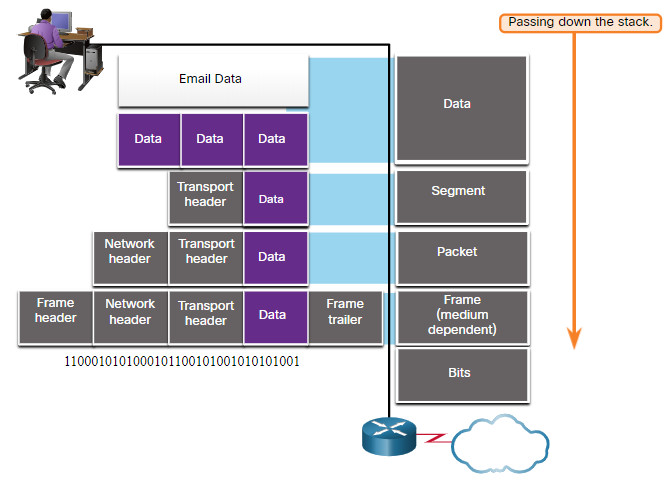 When the receiving host gets the stream of bits, it reverses the process of de-encapsulation. It removes headers layer by layer as the data moves up the stack toward the end-user application.